Free Crypto Wallet Compliance Tool via Telegram
Check Any Wallet for Sanctions, Risk Flags, and Suspicious Behavior
Send a wallet address to our Telegram bot — get an instant PDF compliance report with OFAC & UK sanctions screening, risk intelligence across 29 categories, and behavioral transaction analysis. No signup. No cost.
Wallet Screening Shouldn't Cost $50K or Take 3 Browser Tabs
If you're a compliance officer at a crypto exchange or wallet, you know the drill. A new address comes in. You need to screen it. Your options: pay six figures a year for an enterprise platform you'll use for occasional checks, or open OFAC's website, then the UK sanctions list, then a risk API — manually, separately, with no audit trail.
Enterprise tools are built for enterprise budgets.
Chainalysis, Elliptic, and TRM Labs start at $20K--$200K/year. For a team that needs address screening — not full-scale transaction monitoring — that spend is impossible to justify.
Manual searches leave no proof.
When you check an address on OFAC's SDN search page, there is no downloadable record. When an auditor asks for evidence of screening, you have nothing to show.
Three sources, three workflows, zero integration.
OFAC covers US sanctions. The UK sanctions list covers FCDO designations. Risk intelligence requires separate tools entirely. No free tool combines them. You're doing triple the work for every address.
Transaction-based risk analysis and counterparty analysis are locked behind expensive platforms.
Detecting money laundering patterns, structuring behavior, pass-through wallets, and suspicious counterparty structures requires analytics tools that cost tens of thousands per year. Without them, you're checking static sanctions lists and hoping the wallet's actual transaction behavior is clean — with no way to verify.
We Check Sanctions Lists Too — Then Go Further and Analyze Actual Behavior
Database Lookup
- Check address against known risk lists
- Return a risk score or label
- No analysis of actual transactions
- Same result whether the wallet moved $100 or $10M yesterday
- Opaque scoring — no explanation of why
Behavioral Analysis
- Examine 200 most recent wallet operations
- Detect velocity patterns, layering, structuring, pass-through behavior
- Analyze counterparty structures — fan-in, fan-out, concentration shifts
- Flag suspicious amount patterns — threshold avoidance, mirroring, dust probing
- Transparent thresholds — every flag has a documented reason
Like every other tool, we screen wallets against OFAC, UK sanctions, and 17 risk intelligence categories. But on top of that, we analyze how the wallet actually behaves on-chain — counterparty structures, velocity patterns, amount anomalies. That is the difference between checking a list and understanding a risk.
Three Steps. One Telegram Message. Full Compliance Report.
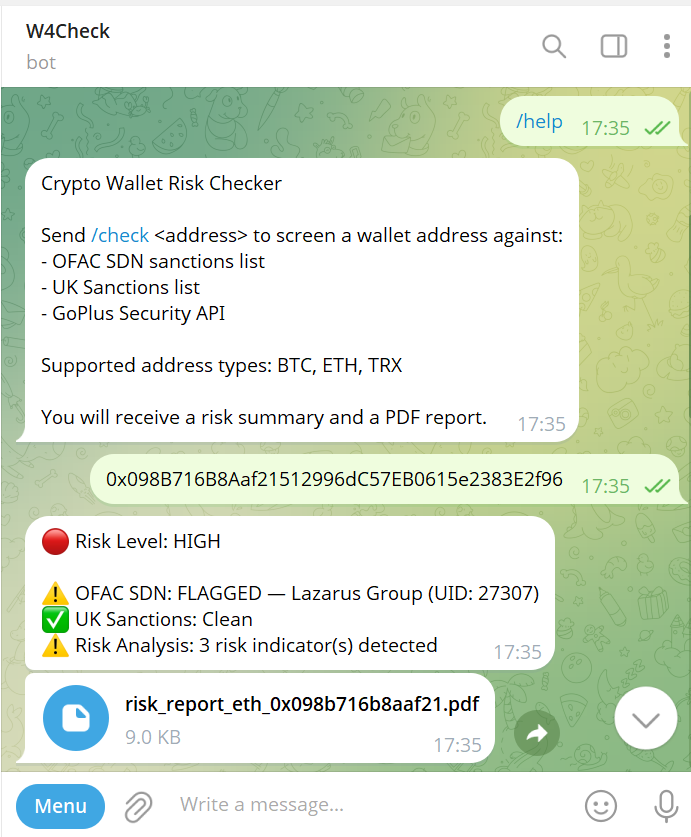
Send an Address
Open Telegram and send any BTC, ETH, or TRX wallet address to w4check using the /check command. No account creation, no API keys, no onboarding forms.
Get Instant Results
Within seconds, w4check screens the address against OFAC SDN and UK Sanctions, runs risk intelligence across 17 categories, and performs 12 behavioral risk checks — including transaction-based risk analysis and counterparty structure analysis — on the wallet's 200 most recent operations. All checks execute in parallel.
Download Your Report
Receive a professional PDF compliance report with risk summary, wallet balances in USD, detailed risk category descriptions, and recent transaction history. File it, forward it to auditors, or attach it to your compliance records.
What Every Check Includes
Two Official Sanctions Databases
- OFAC SDN List — US Department of the Treasury's Specially Designated Nationals list (~1,245 crypto addresses). The legal standard for US-connected transactions.
- UK Sanctions List — UK FCDO designations under SAMLA 2018, with automated extraction of crypto addresses from free-text fields.
- Instant, in-memory lookups against both lists simultaneously.
17 Risk Intelligence Categories
- Covers: money laundering, cybercrime, phishing, mixer usage, darkweb activity, theft, blackmail, financial crime, fake KYC, honeypots, gas abuse, malicious mining, blacklisted addresses, fake tokens, and more.
- Third-party blockchain security data — presented as a unified risk view within every report.
12 FATF-Aligned Behavioral Checks — Transaction Analysis That Goes Beyond List Matching
This is not a static list check. w4check examines actual wallet transactions to detect money laundering patterns, structuring, pass-through behavior, and suspicious counterparty relationships — the same class of analysis that enterprise platforms charge five and six figures to access.
- Counterparty Structure Analysis (4 checks): Fan-out patterns (distribution to many wallets), fan-in patterns (aggregation from many sources), new-counterparty ratio (sudden shifts in transaction partners), concentration instability (changing counterparty relationships). These checks detect layering, smurfing, and money mule behavior by analyzing who the wallet transacts with.
- Velocity & Layering Detection (3 checks): Rapid turnover, retention anomaly, same-day drain detection. Identifies wallets that receive and immediately forward funds — a hallmark of pass-through and laundering activity.
- Amount Pattern Analysis (5 checks): Structuring detection (amounts just below reporting thresholds), repeated amounts, round-number patterns, mirroring, dust probing. Detects deliberate amount manipulation used to evade monitoring.
- Time Anomalies (3 checks — coming soon): Burstiness, off-hours concentration, ping-pong periodicity.
All behavioral checks run on the 200 most recent wallet operations using transparent, quantitative algorithms with defined thresholds — not black-box scoring.
Audit-Ready Documentation
- Three-tier risk level badge: HIGH (sanctions match), MEDIUM (risk flags), CLEAN (no issues found).
- 6 risk group summary — all groups visible in every report, whether flagged or not.
- Token balances with real-time USD values (via DefiLlama).
- Appendix 1: Up to 29 risk category descriptions explaining each flag.
- Appendix 2: 20 most recent transactions with amounts, counterparties, and directions.
Where the Data Comes From
Every check is only as reliable as its sources. w4check draws from official government sanctions lists, third-party blockchain security data, and trusted infrastructure providers. Here is exactly what powers each report.
| Source | Provider | What It Contributes |
|---|---|---|
| OFAC SDN List | US Department of the Treasury | Official US sanctions designations for crypto addresses |
| UK Sanctions List | UK Foreign, Commonwealth & Development Office | Official UK sanctions designations under SAMLA 2018 |
| Blockchain Risk Intelligence | Third-party blockchain security data | 17-category risk intelligence covering money laundering, cybercrime, mixer usage, and more |
| Alchemy | Alchemy (blockchain infrastructure) | Ethereum balance and transaction data |
| TronGrid | TRON Foundation | TRON balance and transaction data |
| DefiLlama | DefiLlama (DeFi analytics) | Real-time USD price data for token balance enrichment |
| CoinGecko | CoinGecko | Token metadata for ~5,000 ETH tokens |
| TRONSCAN | TRONSCAN | Token metadata for top 200 TRX tokens |
- Behavioral algorithms are based on FATF red flag indicators for virtual assets — the international standard for AML risk detection.
- All formulas use defined numerical thresholds, not opaque machine learning models.
- When a data source is unavailable, the report explicitly states what was and was not checked. No silent gaps.
- Behavioral analysis requires a minimum of 10 operations to avoid false positives on low-activity wallets.
- The bot refuses to start if sanctions data fails to load — it will not operate with incomplete reference data.
Every behavioral check uses a defined formula with a specific numerical threshold. No black-box scoring. No opaque AI. When a flag is raised, the report explains exactly why — with the metric, the threshold, and the measured value.
Risk Analysis Aligned with FATF Red Flag Indicators
The FATF identifies six categories of red flag indicators for virtual asset money laundering and terrorist financing. w4check's analysis addresses indicators across every category.
Transaction Size & Frequency
Detects structuring (amounts fragmented below reporting thresholds), repeated fixed-amount patterns, round-number intensity, and micro-transfer probing. Flags wallets where transaction amounts suggest deliberate threshold avoidance.
Transaction Patterns
Analyzes rapid inbound-outbound turnover, same-day drain behavior, retention time anomalies, and near-equal in/out mirroring. Identifies pass-through wallets and layering activity where funds move quickly through intermediary addresses.
Anonymity & Technology
Screens for mixer/tumbler usage, darknet marketplace interaction, honeypot contracts, fake tokens, and other anonymity-enhancing techniques. Identifies wallets interacting with tools designed to obscure fund flows.
Senders & Recipients
Screens wallet addresses and their counterparties against international sanctions lists (OFAC SDN, UK FCDO). Identifies transactions with sanctioned or blacklisted entities.
Source of Funds
Evaluates whether a wallet has received funds from addresses associated with money laundering, cybercrime, theft, phishing, ransomware, or darknet activity. Flags wallets with exposure to illicit fund sources.
Geographical Risks
Sanctions screening covers addresses linked to designated jurisdictions and sanctioned entities. Counterparty analysis identifies interactions with wallets flagged for jurisdiction-based risk.
FATF red flag indicators are designed for VASPs and financial institutions to identify suspicious activity. w4check's checks address on-chain detectable indicators — those observable from blockchain transaction data. Indicators requiring customer identity verification (KYC) are outside the scope of on-chain analysis.
See What Your Report Looks Like
Every check produces a multi-page PDF report designed for compliance records. Here is what is inside.
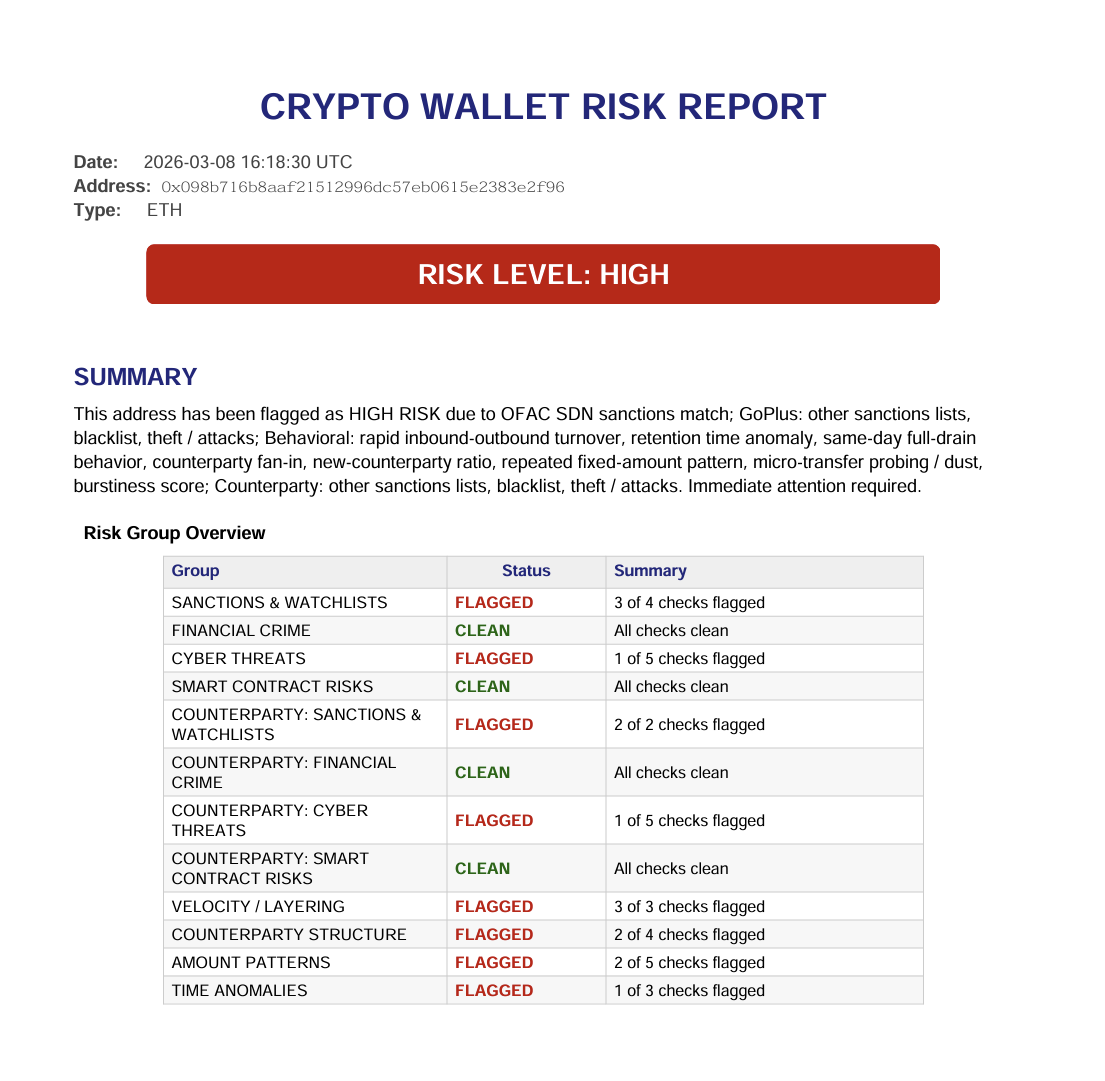
- Risk Summary — Overall risk level (HIGH / MEDIUM / CLEAN) with a summary of all findings across 6 risk groups.
- Wallet Balances — Token holdings with real-time USD values.
- Sanctions Results — OFAC SDN and UK Sanctions screening results, clearly marked.
- Risk Intelligence — Findings across 17 risk categories with explanations.
- Behavioral Analysis — Results from 12 on-chain behavioral checks, organized by risk group.
- Appendix: Risk Descriptions — Detailed explanation of each flagged risk category.
- Appendix: Recent Operations — 20 most recent transactions for manual review.
Two Chains, Analyzed in Depth
We chose depth over breadth. For Ethereum and TRON, w4check doesn't just check a database — it analyzes 200 transactions across 12 behavioral checks, screens against 2 sanctions lists, and runs 17 risk intelligence categories. Bitcoin addresses are screened against both sanctions lists. Full support for additional chains is in development.
| Chain | Sanctions Screening | Risk Intelligence | Behavioral Analysis |
|---|---|---|---|
 Ethereum (ETH) Ethereum (ETH) |
|||
 TRON (TRX) TRON (TRX) |
|||
 Bitcoin (BTC) Bitcoin (BTC) |
— | — |
Full behavioral analysis and risk intelligence require Ethereum or TRON. Bitcoin addresses are checked against OFAC SDN and UK Sanctions lists. Additional chains — including full BTC support — are our top development priority.
Simple Pricing. Full Functionality on Every Plan.
Every feature is available on the free plan. Paid plans only increase how often you can check.
$0
3 checks per day
- OFAC SDN sanctions screening
- UK sanctions screening
- 17 risk intelligence categories
- 12 behavioral transaction checks
- PDF compliance report
- ETH, TRX, BTC supported
- Wallet balances in USD
Start Screening Wallets in the Next 30 Seconds
No account to create. No contract to sign. No invoice to approve. Open Telegram, send a wallet address, and get your first compliance report — free.
Open @w4check_bot in TelegramFree. No account required. Results in seconds.